 Otávio Alves






Olá! I am Otávio Alves, a physicist specialized in the cosmological analysis of galaxy survey data.
I am currently a postdoctoral fellow at the Kavli Institute for the Physics and Mathematics of the Universe, in Japan.
I currently serve as a co-lead of the analysis of models beyond ΛCDM in the Dark Energy Survey collaboration, analyzing the final weak lensing and galaxy clustering datasets (DES Y6 3x2pt).
I also work on the BAO and full-shape analyses of the Dark Energy Spectroscopic Instrument, and serve in its Education and Public Outreach committee.
Before my current position, I was a:
- PhD student in Physics at the University of Michigan, in the United States,
- MSc student in Theoretical Physics at Instituto de Física Teórica, UNESP, in Brazil,
- Undergraduate student in Physics at Universidade Federal de Minas Gerais, in Brazil,
- Technical student in Computer Networks at CEFET-MG, in Brazil.
Saturday Morning Physics
If you’re here because of my Saturday Morning Physics talk, here are 2 interesting links:
Fly through DESI galaxies: highly suggest opening this on a computer and trying out the “fly mode”. Instructions on what keys to press will be shown at the bottom right of your screen.
Legacy survey viewer: access to see galaxies from the Legacy Survey that DESI is measuring spectra from.
If you want to know more about me, most of my current research is focused on constraining cosmological models with data collected by two different galaxy surveys:
Dark Energy Survey
The Dark Energy Survey is a photometric galaxy survey that operated for 6 years at Cerro Tololo, Chile, and obtained shapes and positions for 300M objects.
The shapes of background galaxies are weakly but consistently distorted by the large scale structure of the Universe as light travels through the distribution of matter along the line of sight. This weak gravitational lensing effect combined with measurements of galaxy clustering allowed us to measure the amplitude of density fluctuations and total matter density of the Universe shown in the figure below (partial results from 3 years of data). I was largely involved in showing the robustness of those constraints to different modeling systematics and covariance matrix assumptions.
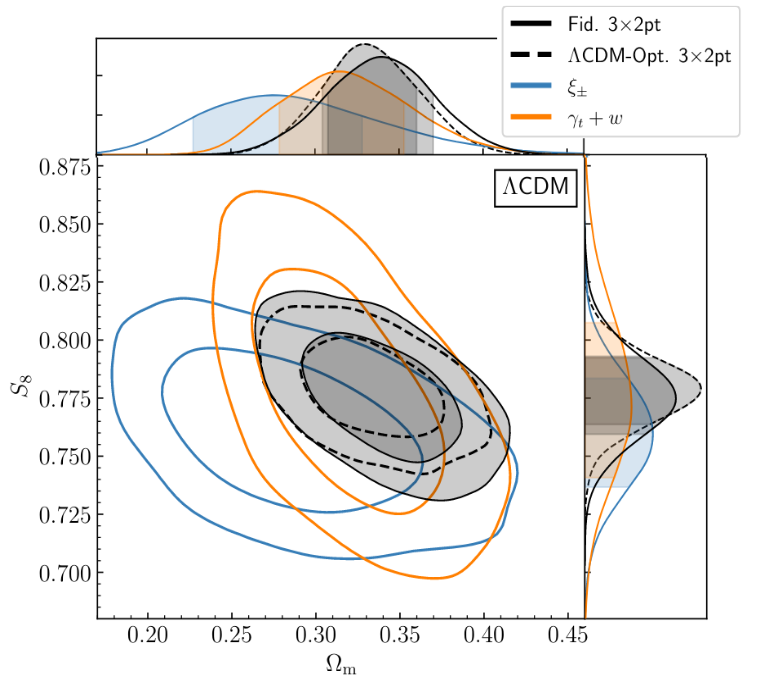
I’m particularly interested in using that data set to study models beyond ΛCDM. I was heavily involved in the Year 3 Extensions analysis and, since 2022, I now serve as a co-lead for the Year 6 Extensions analysis team, which is responsible for the legacy DES 3x2pt constraints on physics beyond ΛCDM.
Dark Energy Spectroscopic Instrument
The Dark Energy Spectroscopic Instrument is a spectroscopic galaxy survey operating at Kitt Peak, USA, and measuring the optical spectra of tens of millions of galaxies and quasars. Galaxy spectra provide accurate redshift measurements that can be used to map the 3D distribution of those objects.
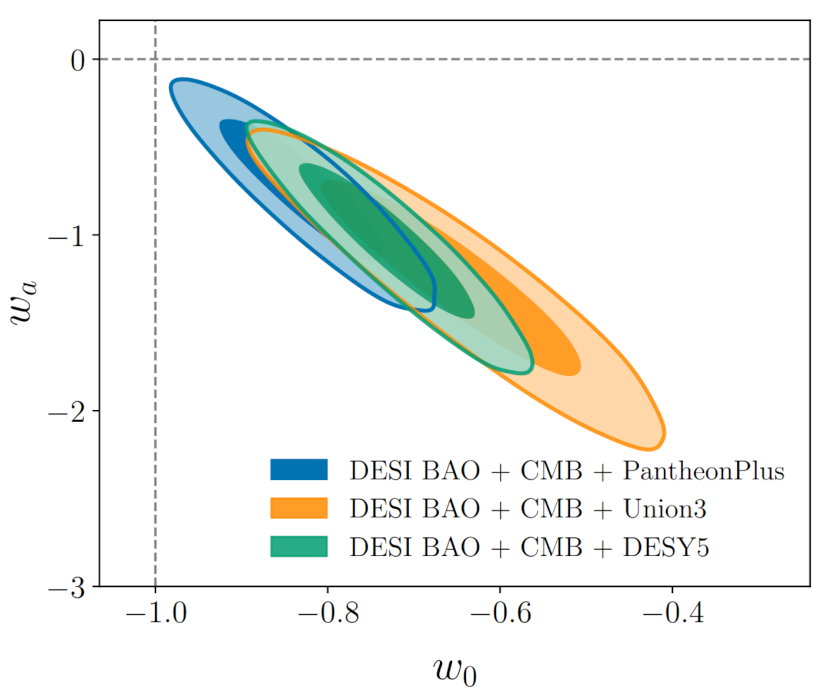
The 3D galaxy & quasar map produced by DESI allowed us to trace the expansion history of the Universe by measuring the Baryon Acoustic Oscillations physical scale at different redshifts as it expands along with the Universe. The Friedmann equations show that this expansion is sensitive to the energy content of the Universe, meaning that the BAO distance measurements can help constrain, e.g., the dynamics of Dark Energy and the sum of neutrino masses.
When combined with data from supernovae type Ia and cosmic microwave background, the BAO measured from the first year of DESI data yielded intriguing results for Dark Energy:
Within DESI, I’ve been particularly working on implementing and validating analytical methods to estimate the covariance matrices for the full-shape analysis of DESI power spectra. Because that effort will be equally useful for other current-generation spectroscopic surveys, our code is being made publicly available at:

The unique capacity of DESI to measure 5000 spectra every 30 minutes comes from, among other things, an army of 5000 robotic positioners built at the University of Michigan.
More about me
I was born and raised around (20°S, 44°W) amidst the beautiful transition from Mata Atlântica to Cerrado.
I’m usually excited about most things: computer science, non-computer science, generative art, non-generative art, Brazilian literature, non-Brazilian literature, classical music, non-classical music, etc. Browse through my website to see more of what I do.
(updated April 03, 2026)